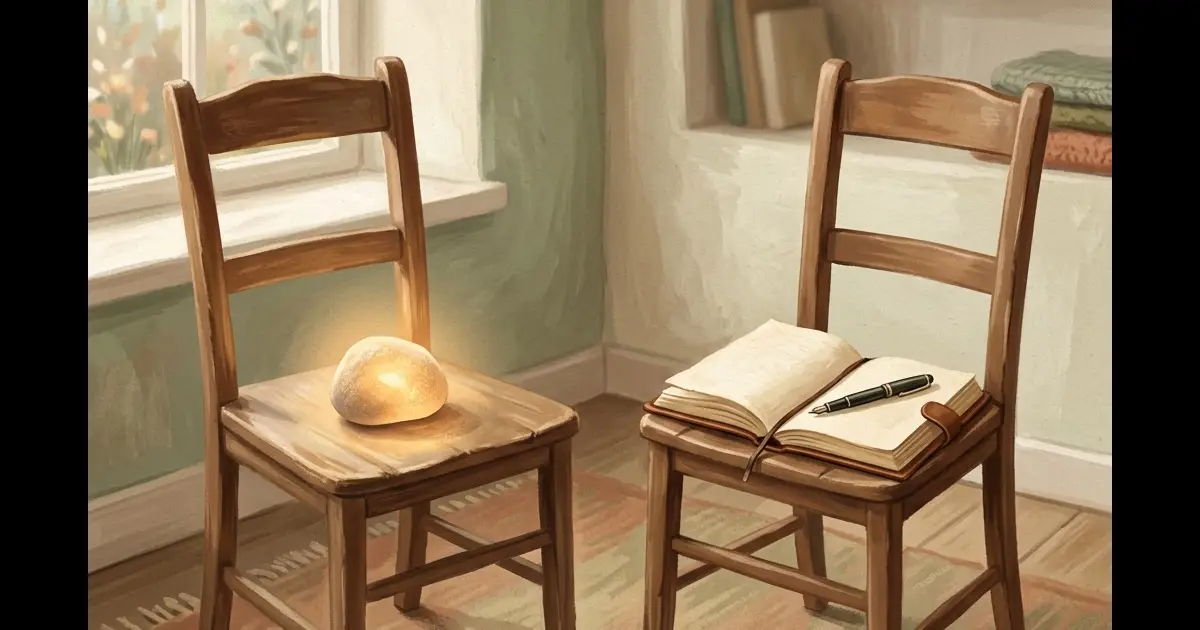
An inner child dialogue is a guided conversation between your present adult self and a younger part of you. You ask that part how it feels and what it needs, then answer it with the compassion and reassurance it did not reliably receive. It sounds simple, but it reaches emotions that thinking and analyzing rarely touch, which is why it sits at the heart of inner child work.
It is one of the most powerful of the inner child healing exercises, and a good first technique to learn because it needs no special tools, just a few quiet minutes.
Why dialogue works when thinking does not
You can understand your patterns perfectly and still feel stuck, because old wounds are stored as feeling and body memory, not as logic. Dialogue works because it speaks to the part in its own language: relationship and tone. When a frightened younger part is met with warmth instead of analysis, the nervous system registers safety. This is the same principle behind Internal Family Systems, which treats the inner child not as a metaphor but as a real part of you worth listening to.
How to start an inner child dialogue
1. Create a little safety first
Choose a calm, private moment. Take a few slow breaths, soften your shoulders, and let your body settle. You are creating the kind of safe space a child needs before they will open up.
2. Picture your younger self
Bring to mind an image of yourself at a younger age, perhaps from a photo, perhaps just a felt sense. There is no need to force a vivid picture; an impression is enough.
3. Greet them and ask one open question
Say hello inwardly, warmly. Then ask something simple and open: “How are you feeling?” or “What do you need me to know?” The point is not to interrogate but to invite.
4. Listen without correcting
Whatever comes, sadness, anger, silence, let it be there without fixing or judging it. Most younger parts have rarely been listened to. Simply staying and listening is already healing.
5. Respond with what they needed to hear
Offer the words that were missing: “I see you.” “It makes sense that you felt that way.” “You are safe now, and I am not going anywhere.” Then, where life allows, act in line with those words.
Ways to hold the conversation
There is no single right format. Some people speak aloud, some write it as a back-and-forth between “Adult” and “Child” on the page, and some do it silently. Writing can make it easier to slow down and really hear the younger voice. A guided meditation can also lead the dialogue for you; see our inner child healing meditation tips for how that works.
What to do if it feels like too much
If the dialogue stirs up intense grief or fear, that is not failure, it is contact with something real. Slow down, place a hand on your chest, name a few things you can see and hear to ground yourself, and pause. Deep wounds are best approached gently and, when needed, with a therapist alongside you.
Where to go next
Dialogue opens the door; reparenting keeps it open. Once you can hear your younger self, the next step is learning how to reparent yourself day to day. And if you would like a session built around your own memories and pace rather than a generic script, you can request a free personalized inner child meditation, created by a therapist.