We’ve all been there: you’ve read the self-help books, you’ve pinpointed exactly why your past affects you, and you understand your “patterns” intellectually. Yet, a few days later, you find yourself reacting with the same hair-trigger temper or falling back into that familiar, draining loop of people-pleasing. It’s a frustrating cycle that leaves most of us feeling “stuck”—ashamed that we know better, yet still can’t seem to do better.
The truth is that healing your inner child isn’t just an intellectual exercise; it is a full-body reconstruction. Drawing from the principles of Holistic Psychology, here are the most impactful takeaways on how to actually do the work of healing your youngest self.
Here are the basics of inner child healing, sumarized in this infographic if you need it, so we can go beyond the basic.
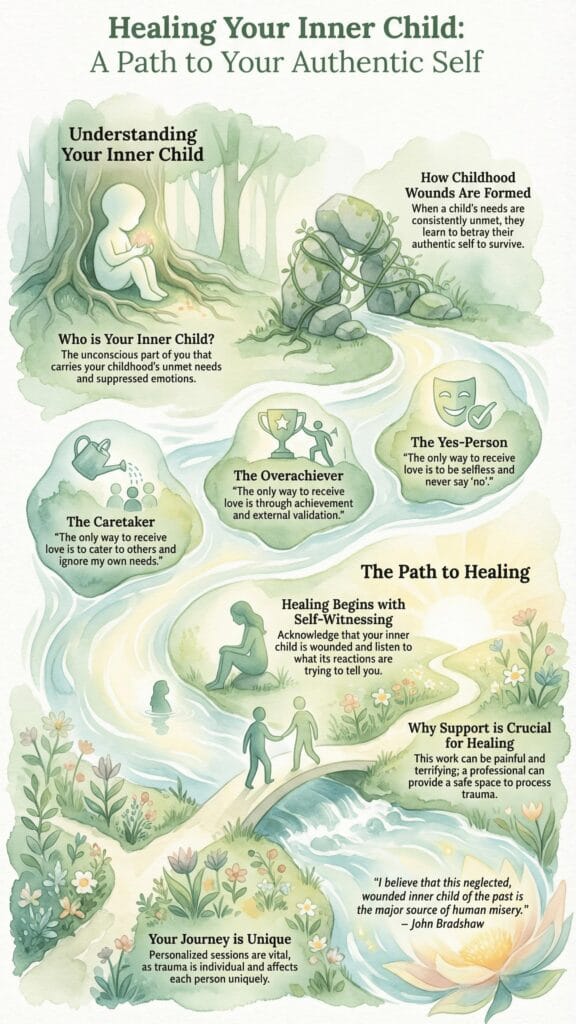
1. Trauma is subtler (and more common) than you realize
Most of us reserve the word “trauma” for catastrophic, life-altering events. However, a more accurate and helpful definition is any negative life event “that occurs in a state of relative helplessness”. This means trauma can be as subtle as a parent who was physically present but emotionally distracted, or a home environment where you felt you had to hide your true feelings to be “good”.
When your emotional needs were consistently unmet, your child brain—which is in a “spongelike” state of absorption—internalized a devastating message: I must betray who I am in order to survive. This “spiritual trauma” results in a severed connection to your authentic self that persists into adulthood.
“Not everything that is faced can be changed, but nothing can be changed until it is faced.” — James Baldwin
2. Your body might be addicted to your past stress
One of the most counter-intuitive reasons we stay stuck is “emotional addiction”. If you grew up in a chaotic or high-stress environment, your body became acclimated to high levels of cortisol and adrenaline. As an adult, your subconscious mind actually seeks out familiar stress because “peace” feels threateningly unfamiliar or even dull.
You might unconsciously pick fights or over-analyze a partner’s text because your body is quite literally looking for its next biochemical “hit” of the familiar drama you lived as a child. Healing requires breaking this physical cycle, not just the mental one.
3. You are the witness, not the script
We often live as if the script running through our heads—the “monkey mind”—is our true identity. We “practice” these thoughts all day long until they feel like facts, but thoughts are merely electrochemical responses in the brain.
Healing begins when you develop your “attention muscle” through consciousness. When you realize that you are the thinker of your thoughts, not the thoughts themselves, you create the distance needed to choose a new reaction. You aren’t “unworthy”; you are simply having a practiced thought of unworthiness.
4. Healing starts “below the neck”
You cannot heal a dysregulated mind with a dysregulated body. Because your vagus nerve connects your brain to almost every major organ, your physical state dictates your emotional capacity. If your nervous system is stuck in “fight-or-flight,” your brain will continue to see threats where there are none.
“Bottom-up” practices—like deep belly breathing, cold therapy, or yoga—signal to your brain that you are safe. By toning the vagus nerve, you increase your tolerance for stress, allowing you to finally exit “survival mode” and enter the state of social engagement where true connection happens.
5. Personalization is the key to breaking through
While general advice is helpful, inner child work is deeply individual. Your specific wounds—whether they stem from a parent who denied your reality or one who vicariously lived through you—require tailored tools.
At My Inner Center , we recognize that listening to a generic inner child meditation on YouTube is often not enough. In fact, it can even be harmful if it inadvertently triggers your specific trauma response without providing the right anchor. This is why we offer 1 free personalized inner child session tailored just for your unique needs. Our team uses proven, asynchronous techniques like breathwork, visualizations, and reparenting exercises to help you meet your specific inner child exactly where they are.
“I believe that this neglected, wounded inner child of the past is the major source of human misery.” — John Bradshaw
6. Reparenting: Building self-trust through “loving discipline”
The goal of inner child work is not to change the past, but to give yourself today what you didn’t receive back then. This involves moving away from the “critical inner parent” who shames you and developing a “wise inner parent” who validates your feelings without judgment.
The most powerful way to build this bond is through “loving discipline”: making small, daily promises to yourself—like drinking a glass of water or meditating for two minutes—and actually keeping them. Each kept promise acts as a brick in the foundation of self-trust, proving to your inner child that you are finally a reliable guide.
Healing your inner child is a daily, conscious choice to stop living on autopilot. It is the process of “letting a part of yourself die so that another part of you can be reborn”. As you begin to look in the mirror with more compassion, ask yourself: What is one small promise I can make to myself today to show my inner child that I am finally listening?